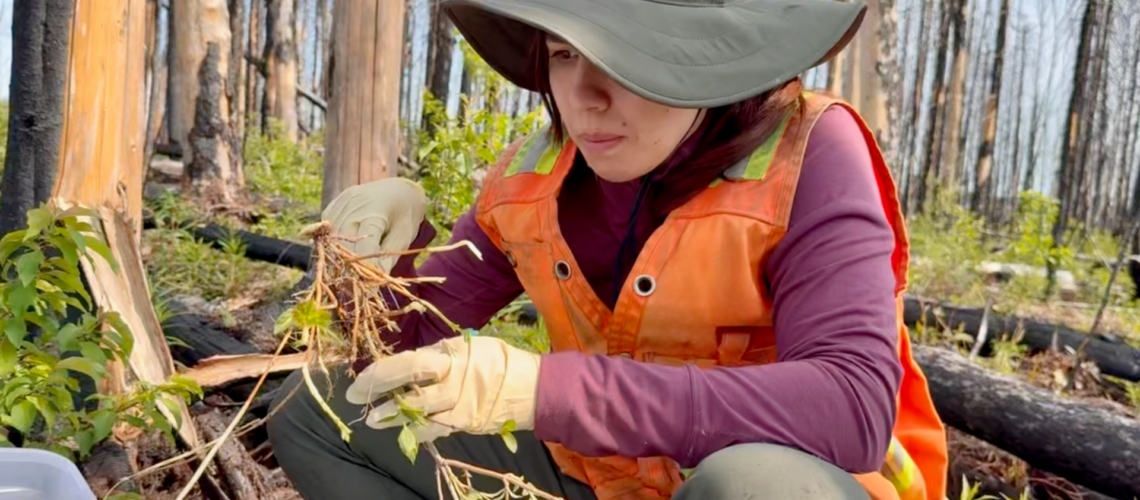
As wildfires continue to intensify across Canada each summer, Master of Biology student Roxane Bergeron is studying how soil ecosystems and climate change influence the ability of trees to regrow after wildfire events, a key factor in determining how forests recover after disturbance.
Her research explores whether soil organisms act as barriers or supports for tree species shifting northward due to warming temperatures, with important implications for post-fire regeneration and long-term forest resilience. With fire seasons becoming longer, more frequent, and more severe, this study is addressing a critical and immediate challenge affecting communities, ecosystems, and economies across the country.
“Wildfires are becoming more frequent and intense, and we need to better understand what happens after the fire,” said Bergeron. “My research looks at whether the soil itself can help or hinder new tree growth as our forests respond to climate change.”
Her findings suggest that while many tree species can adapt to new soil conditions, some, including sugar maple, may face challenges in fire-disturbed boreal environments. The research highlights the role of specialized soil fungi and underscores the complexity of post-fire recovery.
“These findings are important for how we approach forest management and reforestation,” said Dr. Pedro M. Antunes, Professor and Canada Research Chair (Tier II) in Plant and Soil Ecology at Algoma University, and co-supervisor of Bergeron’s research. “As wildfire activity increases, understanding how ecosystems recover is essential to building more resilient forests.”
Bergeron recently presented her research at the Global Soil Biodiversity Conference in Victoria, British Columbia, where scientists from more than 50 countries gathered to discuss ecosystem health and climate response.
Supported by a Natural Sciences and Engineering Research Council of Canada (NSERC) Discovery Grant, this study is part of a broader effort at Algoma University to generate knowledge that supports climate adaptation and sustainable forest management. It also reflects Algoma University’s growing role in advancing research that responds directly to real-world environmental challenges, particularly those impacting Northern Ontario and communities across Canada.
To learn more about the Master of Science in Biology at Algoma University, visit algomau.ca.
Share Article